Whenever I visit my brother at his home in Rotorua, I do one of two things: I sit mesmerised by hands that repeatedly fold, unfold, crease, crumple, pucker, and pleat a square piece of paper into an intricate and beautiful design, or I leap out of my chair to prod and poke the overwhelming smorgasbord of paper creations on display around the room.
Lizards, crabs, fish, and lobsters line the walls, and ornamental dragons, dinosaurs, and rhinoceros fill shelves. Unique and beautiful tessellated bowls and lampshades defy logic, and complex modular creations with names like icosahedron and dodecahedron decorate the room. There are thousands of incredibly intricate folds, multi-folds, and swirling patterns. I never tire of visiting and always leave with a sense of wonder at the limitless potential of the creative spirit.

My brother Jonathan is an Origami artist. Origami is the Japanese word for paper folding. ORI means to fold, and KAMI means paper. Though not the case for our family, origami is an art form once handed down from parent to child through many generations. Today, it is widely practised across the world.
Jonathan has worked in the visual arts field for more than 50 years. Somebody once called him the ‘Bruce Lee’ of origami. It’s not a term Jonathan is particularly comfortable with, but there are similarities. Like Lee and his martial arts, he is unswervingly committed to his craft and, like his namesake, unless it’s for a major art installation, Jonathan prefers adhering to the pure rules of origami – no cutting and no glueing. Regarding origami, Jonathan sits alongside the best origami artists in the world.
While origami has its roots deep in history, Jonathan says it is an evolving art, continuing the traditions while taking conventions to the next level beyond the folded edge. Flabbergasting intricate multi-folds, modular creations, and swirling patterns are the threshold of this new direction. I pick up a framed piece of work and read the label, ‘One piece of paper, No cutting or glueing, One thousand folds, One journey’. Mind-boggling!
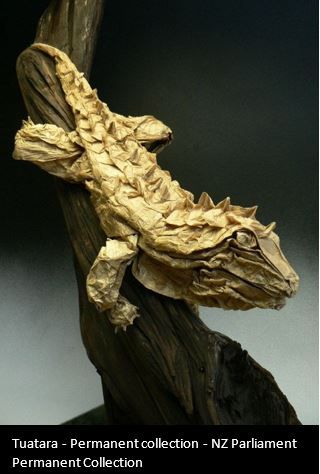
In 1999, Jonathan was one of 5 people from around the world invited by Japan’s greatest origami master, the grandfather of modern origami, the late Akira Yoshizawa, to exhibit with him in a Tokyo gallery. Jonathan regales the story of once coming second place behind Yoshizawa when participating in a complex paper folding activity during an origami conference in Japan. Sound simple? The difficulty was that he said, “We had to fold with our hands behind our backs, using only chopsticks!”
When I tell people my brother is an origami artist, their eyes usually glaze over, and a hand moves over their mouth to hide a smirk. The conversation shifts from the artist to the art or, more pointedly, to whether origami deserves to be called art or a craft.
Yes, visions of paper cranes, boats and planes float to mind for most of us when thinking about origami. One of my favourite games as a child was the paper fortune teller, sometimes called a cootie catcher. I’m sure we’ve all made these at some point in time. A piece of paper folded with flaps that, when lifted, foretells a future career, a favourite colour or number. This is the origami experience for most people. Jonathan admits it has taken centuries for origami to be accepted as a proper art form.
“For much of the time, origami is relegated to something children do. The last 50 years have seen a dramatic turnaround, going from a hundred or so simple designs to over 80,000 published designs and probably just as many unpublished ones. These range in complexity from a few dozen folds to more than 1000 folds in a single sheet. Exhibits at the Cooper Hewitt in NYC, the Mingei in San Diego, and the Louvre in Paris have helped change the opinion of origami.”
Most people practice origami as a craft, but only a few use it as art, science or mathematics. Today’s origami enthusiasts are as likely to be theoretical mathematicians as they are artists. Engineers are applying origami techniques to robotics, architecture, medicine and aerospace applications—the space industry in learning how to unfold giant surfaces such as solar sails and telescopes in space. The auto industry has airbags, devices that must unfold effectively in less than a second. Crumple zones behind bumpers where strategic folds in metal can absorb high energy impact. Medicine, the stent familiar to many seniors, is a device that relies on a very simple origami fold to open inside the artery to relieve pressure. Nanotechnology and DNA proteins that fold and create molecular hinges are just a few. It seems origami is limitless in its potential.
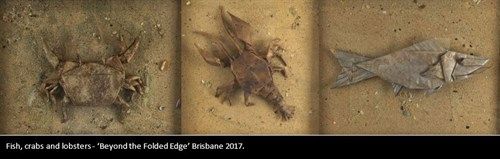
Of all the accolades Jonathan has received, the one he cherishes most is ‘teacher’. In New Zealand, Jonathan formed Origami New Zealand (ONZ) to bring the art form to the public through exhibits, demonstrations, workshops, and installations using contemporary designs in paper folding. His organisation was awarded funding to create The Great Origami Maths and Science Show, which toured throughout New Zealand to college audiences. Who would have thought that paper could be such an excellent tool for learning, and who would have thought there was so much knowledge buried in the folds of origami? It is much more visible, doable and touchable when you can see mathematical principles unfold before your eyes.
Jonathan is an accomplished artist who has sold work at fine art shows and galleries in the United States, Australia, and New Zealand.
Most of my siblings, including myself, struggle to draw a straight line with a ruler, so Jonathan has always been a bit of a conundrum to us because of his artistic talent and his ability to pursue and be successful at any of his creative passions.
As a child, he continually built, made, painted, or performed. The doll’s house was complete with furniture; his matchstick builds, the Meccano creations, and plasticine sculptures. He loved nothing more than to usher us into the lounge to watch his latest magic show or listen to his latest sequel of limericks and theatre pieces. But why origami? Jonathan says he finds intense enjoyment and mental stimulation from making things.
“To bring something from an idea to a simple sketch, then into actual reality where you can actually touch is a challenge I’ve always been motivated to apply myself. Whether it’s wood, metal, glass, plastics, fabrics, clay, large-scale, handheld or miniature, I’ve explored many art forms in my lifetime. Along this journey, I discovered paper folding, which, over the decades, has continued to fascinate, challenge, and reward me for my efforts.”
Although there is and always will be only one origami artist in our family, we are all marked in some way with the spirit of origami. As far back as I can remember, family celebrations always shared components of origami. Christmas cards decorated with folded elves peeking out of Christmas stockings, a folded bouquet of red roses for Mum, and jumping frog games tumbling out of Christmas crackers. Gifts of origami dogs, cats, penguins, and dragons fill our cabinets, inspiring lively conversations.
“Origami has always had a spirit of sharing, which lends itself well to social interactions with others, either as a student or teacher. It is inexpensive, a pleasurable past-time, with an end product somebody can often gift,” Jonathan says.
No, he may not be comfortable being called the Bruce Lee of origami, but one thing I know for sure—Jonathan Baxter is most definitely the Bruce Lee of brothers, albeit a brother with a very unusual occupation.
 Fiftypluskiwi
Leave a reply to Maria Jenkins Cancel reply